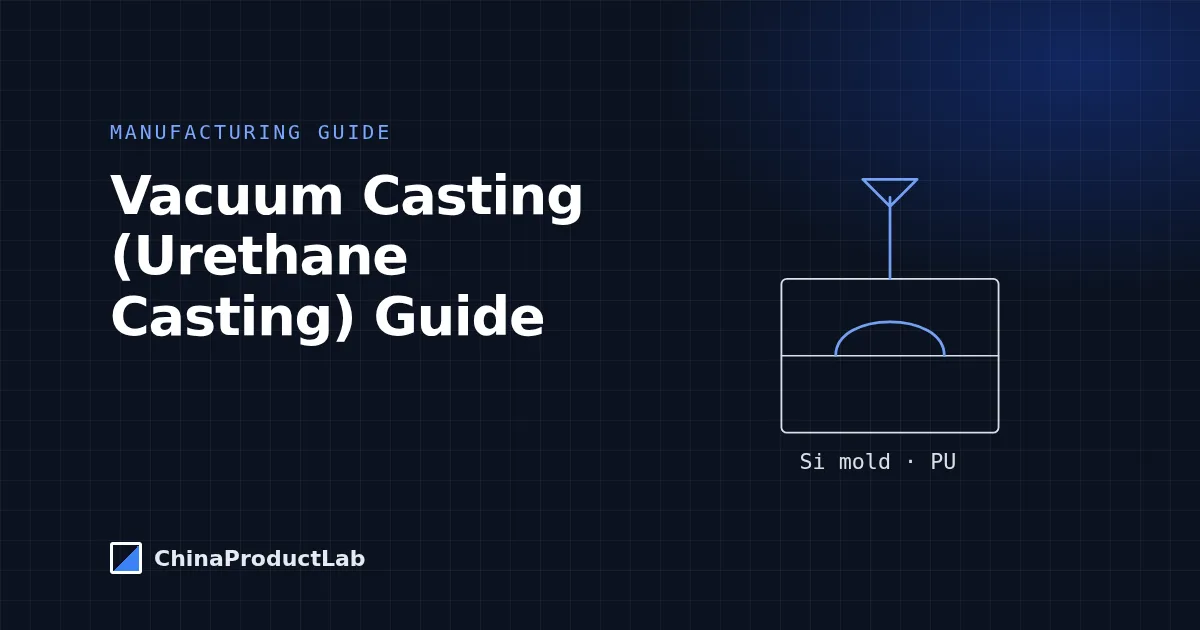
You need 30 units for user testing, a trade show or a crowdfunding video. 3D printed parts look like prototypes; an injection mold is too expensive and too slow for 30 parts. Vacuum casting sits exactly in between: parts that look and feel molded, in colors and soft-touch materials, without steel tooling.
How it works
- A master pattern is made, usually by SLA printing or CNC machining, and finished to the surface you want.
- The master is encased in liquid silicone, which cures into a flexible mold that is then cut open.
- Two-part polyurethane resin is poured into the mold under vacuum to avoid bubbles, then cured.
- Each silicone mold typically produces in the order of 15–25 parts before detail degrades; more parts need more molds.
Materials
| Polyurethane type | Simulates | Use |
|---|---|---|
| Rigid, general purpose | ABS | Housings, covers |
| Tough, impact resistant | PC / PP-like behaviour | Clips, functional parts |
| Clear | PMMA / PC | Lenses, light guides, windows |
| Elastomeric (various Shore A hardness) | TPE / rubber | Grips, seals, soft-touch areas |
| Higher temperature grades | Engineering plastics (partially) | Parts near warm components |
Polyurethanes simulate production plastics — stiffness, heat resistance, chemical resistance and flame ratings are not identical. Do not use cast parts for certification or final validation testing.
Strengths and limits
- Strengths: molded appearance, colors and textures, soft-touch overmolding effects, inserts, fast compared with tooling.
- Limits: small quantities per mold, lower dimensional precision than machining or molding, material properties differ, very large or very thin parts are difficult.
When to choose it
- User trials and market tests needing 10–50 good-looking units
- Marketing samples, photos, videos, trade shows
- Soft-touch or clear parts that printing cannot match
- Low-volume end-use parts where appearance matters more than engineering properties
For more units or real material properties, look at aluminum and bridge tooling. Compare all options in rapid prototyping methods, or request a quote with your quantity and finish.