Two CNC quotes for the “same” part can differ several times over. Usually it is not the hourly rate that explains the gap, but how each supplier reads your drawing: how many setups they need, which tolerances they take seriously, and what they assume about finishing and inspection. Understanding the cost drivers lets you compare quotes fairly — and design parts that are cheaper to make.
The cost structure of a machined part
| Cost element | What drives it | Scales with quantity? |
|---|---|---|
| Programming & setup | Part complexity, number of setups, fixtures | Fixed per batch — shared across all parts |
| Material | Alloy, stock size (bounding box + allowance), availability | Per part |
| Machining time | Volume of material removed, feature count, tool changes, tolerances | Per part |
| Finishing | Anodizing, plating, painting, masking requirements | Per part, often with a lot minimum |
| Inspection | Number of critical dimensions, report requirements | Per part / per batch |
| Packaging & logistics | Protection level, weight, shipping method | Per shipment |
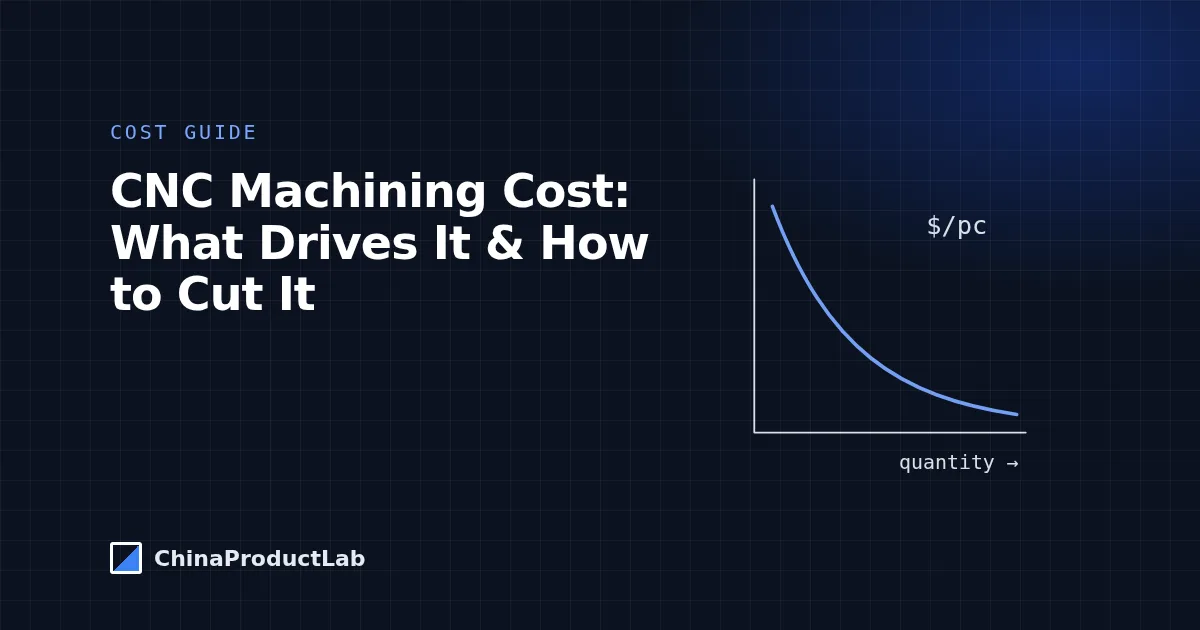
Because programming and setup are fixed per batch, the unit price of one prototype can be many times the unit price at 100 pieces. Always ask for quotes at two or three quantities.
Seven design decisions that drive cost
- Tolerances. Tight tolerances on every dimension slow machining and add inspection. Specify tight tolerances only on functional features and use a general tolerance standard (e.g. ISO 2768-m) for the rest.
- Number of setups. Features on many faces require re-fixturing or multi-axis machines. Group features on as few faces as possible.
- Internal corners. Cutters are round; sharp inside corners need small tools or EDM. Add a corner radius slightly larger than the tool radius.
- Deep pockets and thin walls. Depth beyond roughly four times the tool diameter, or thin walls that vibrate, force slow cutting.
- Material choice. Free-machining alloys (e.g. 6061 aluminum, 303 stainless, brass) cut faster than hard or gummy materials (titanium, 316 stainless, some plastics).
- Threads and small holes. Standard thread sizes and depths avoid special tools; very small holes are slow and break tools.
- Cosmetic requirements. “No visible tool marks” on all surfaces can double finishing effort. Define cosmetic (A) surfaces explicitly.
How to compare quotes fairly
- Same quantity, material grade and finish on every quote
- Clear statement of which tolerances will be inspected and how
- Whether material certificates and inspection reports are included
- Packaging and Incoterm (EXW vs DDP can change the comparison completely)
- Lead time and what happens if a part is out of tolerance
When CNC is the wrong process
At higher volumes, parts that are mostly material removal may be cheaper as castings, extrusions or molded parts with light machining. For prototypes with complex shapes, 3D printing may be faster. See CNC vs 3D printing and our CNC machining page — or send a drawing for an itemized quote with DFM suggestions.