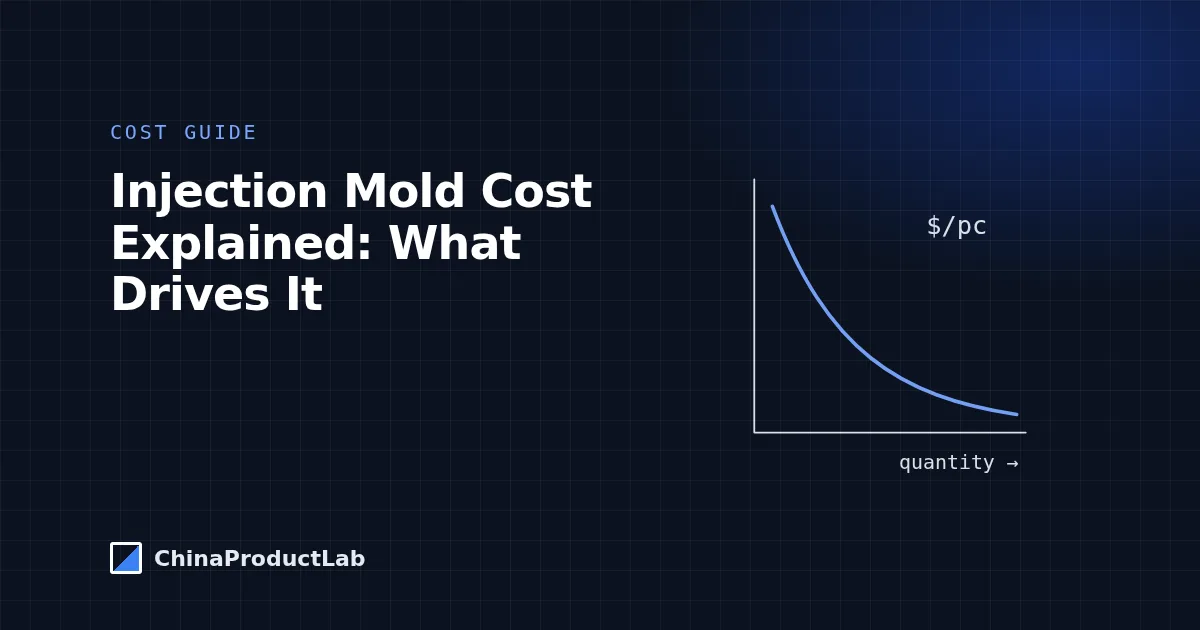
Injection molding has two prices: the mold (a one-time investment) and the part (cost per shot). A cheap mold can make every part more expensive or wear out early; an over-specified mold can lock up capital you do not need yet. The right choice depends mainly on your expected volume over the product’s life.
What drives mold cost
| Factor | Effect on mold cost | Design lever |
|---|---|---|
| Part size | Larger mold base and more machining | Split very large parts if it simplifies tooling |
| Complexity | More machining, EDM and fitting | Simplify geometry; uniform walls |
| Undercuts | Need slides or lifters (moving mold parts) | Redesign clips/holes to mold straight (pass-through cores) |
| Number of cavities | More cavities = higher mold cost, lower part cost | Start with 1–2 cavities; add later |
| Steel grade | Hardened steel costs more but lasts far longer | Match steel to lifetime volume |
| Runner system | Hot runners cost more up front, save material and cycle time | Cold runner often fine for low volume |
| Surface finish | High polish / textures add finishing work | Polish only visible surfaces |
| Tolerances | Tight tolerances need more precise tooling and trials | Tighten only functional dimensions |
What drives part cost
- Cycle time — dominated by cooling time, which grows quickly with wall thickness
- Material — resin price and part weight (including runner waste on cold runners)
- Cavities — more parts per shot
- Secondary operations — printing, assembly, inserts, packaging
- Machine size — set by part size and clamping force
Choosing the mold class for your volume
| Tool type | Typical use | Trade-off |
|---|---|---|
| Aluminum / prototype tool | Validation builds, hundreds to low thousands of parts | Lowest tooling cost; limited life and fewer features |
| Pre-hardened steel (e.g. P20-class) | Low to medium production volumes | Balanced cost and life |
| Hardened steel (e.g. H13 / S136-class) | High volumes, abrasive or glass-filled resins | Highest cost; longest life and stability |
Mold life is usually stated in shots. Ask the supplier which mold class they quote and what shot life they guarantee — two quotes for “a mold” can describe very different tools. See also low-volume and bridge tooling.
Questions to settle before you pay for tooling
- Who owns the mold, where is it stored, and can you move it to another supplier?
- How many design changes (tool modifications) are included?
- How many sample rounds (T1, T2…) are included, and what is the approval process?
- What maintenance is included over the mold life?
- Is the part design DFM-reviewed (draft, walls, gates, ejector marks)?
Our injection molding page describes the process from DFM to production. To get an itemized mold and part quote, send us your STEP file with expected annual volume.